VB-G RAM G vs MGNREGA 2026: New Rules, 125 Days Guarantee & Job Card List
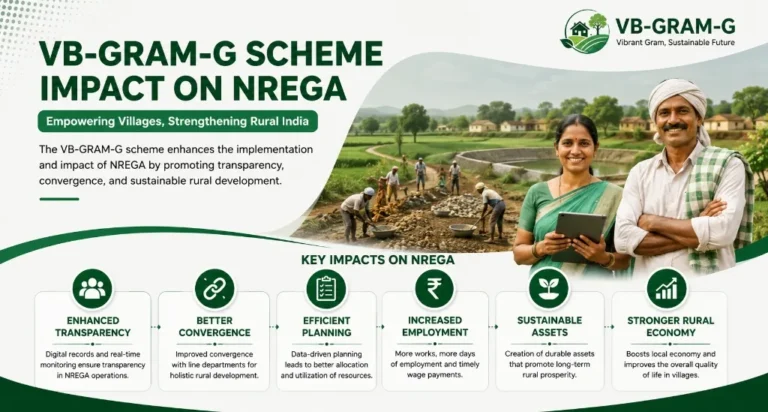
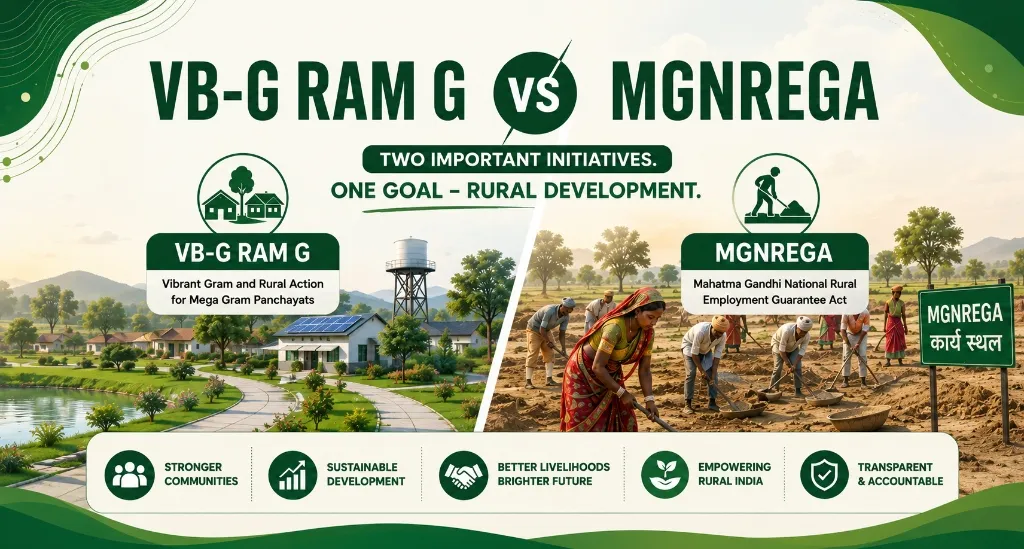
Understanding the transition from VB-G RAM G vs MGNREGA is essential for millions of rural workers across India as the government rolls out major structural updates to the national employment guarantee framework. Under the newly enacted Viksit Bharat Guarantee for Rozgar and Ajeevika Mission framework, the flagship rural employment program has received enhanced budgetary allocations, updated digital verification protocols, and an expanded safety net for rural households. This comprehensive guide outlines everything you need to know about the key differences between the original scheme and the modern Viksit Bharat framework.
The Mahatma Gandhi National Rural Employment Guarantee Scheme has long served as a vital financial lifeline for rural families. However, the introduction of the Viksit Bharat VB-G RAM G vs MGNREGA initiative marks a historic shift toward higher annual work allocation, stricter digital attendance tracking, and streamlined direct benefit transfers. Whether you are looking to register a new household job card or trace pending wage payments, navigating these updated rules will help you maximize your statutory rights.
As the central Ministry of Rural Development implements these changes nationwide, rural wage earners can now access expanded work opportunities, improved worksite facilities, and faster bank credit settlement cycles. Below is a detailed breakdown of how the updated scheme compares to the legacy structure and what steps you must take to secure your benefits.
[Hide]
- 1.Understanding VB-G RAM G vs MGNREGA Framework Differences
- 2.Expansion of Employment Guarantee from 100 Days to 125 Days
- 3.SECC 2011 Eligibility Verification for VB-G RAM G Job Card
- 4.Updated Daily Wage Rates in 2026 Across States
- 5.NMMS App Attendance and Digital Geo-Tagging Mandatory Rules
- 6.FTO Tracking and ABPS Payment Direct Benefit Payouts
- 7.Step-by-Step Registration Process for New Household Job Cards
- 8.Frequently Asked Questions FAQs
Understanding VB-G RAM G vs MGNREGA Framework Differences
The primary evolution between the legacy MGNREGA structure and the new VB-G RAM G vs MGNREGA framework lies in administrative digitisation, enhanced budgetary support, and expanded statutory work entitlements. While the core mission of guaranteeing manual labor opportunities remains intact, the administrative operational layer has been completely upgraded to eliminate ghost cards and mandate real-time worksite verification.
Under the traditional MGNREGA system, paper muster rolls were maintained manually by local mates or Panchayat secretaries, which occasionally led to reporting delays and delayed wage disbursemnts. In contrast, the Viksit Bharat framework relies entirely on satellite geo-tagging, mobile monitoring applications, and direct biometric verification. This ensures that every work demand, muster roll issue, and payment processing step is logged instantaneously on the central Management Information System.
Furthermore, the VB-G RAM G vs MGNREGA framework aligns rural asset creation with long-term climate resilience and sustainable agricultural development. Worksites are prioritized based on regional watershed management, flood control embankments, and village road infrastructure, creating durable assets while providing immediate wage relief to local families. This comprehensive modernisation enhances both project durability and institutional governance across rural districts.
Social Audit and Public Governance Improvements
Institutional oversight has also been strengthened under the Viksit Bharat framework. Social audit committees under VB-G RAM G vs MGNREGA operating at the Gram Sabha level conduct regular public verifications of completed worksites, verifying muster roll logs against bank transaction statements. This multi-tiered transparency framework guarantees that rural funds reach intended beneficiaries without leakage or middleman intervention.
Expansion of Employment Guarantee from 100 Days to 125 Days
One of the most significant upgrades under the Viksit Bharat framework is the expansion of the annual work guarantee. Under the statutory provisions of the original 2005 Act analyzed in VB-G RAM G vs MGNREGA, rural households were limited to a maximum of 100 days of guaranteed wage employment per financial year. Under the newly expanded VB-G RAM G vs MGNREGA framework, eligible rural households can now demand up to 125 days of guaranteed work annually.
This additional 25-day extension under VB-G RAM G vs MGNREGA provides substantial extra income security for agricultural laborers during lean seasons when seasonal farming jobs are unavailable. State governments across India have approved expanded rural development budgets to support this increased work allocation, ensuring that local Block Development Officers maintain an active inventory of approved projects.
To claim your full entitlement of 125 days, household heads must follow three core steps:
- Submit a formal written work demand or digital application to the local Gram Panchayat office.
- Obtain a dated receipt from the Panchayat Executive Officer as proof of work request submission.
- Receive work allocation within 15 days within a five-kilometer radius of your village residence.
Unemployment Allowance Rule: If the local Gram Panchayat administration fails to provide work within 15 days of receiving your formal demand, you are legally entitled to receive a daily unemployment allowance paid directly from the state government fund.
SECC 2011 Eligibility Verification for VB-G RAM G Job Card
Eligibility under the Viksit Bharat framework is cross-referenced with the Socio-Economic and Caste Census database for VB-G RAM G vs MGNREGA alongside local Gram Panchayat records. To ensure that benefits reach genuine rural households, the registration system verifies household criteria, residency status, and adult member willingness to perform unskilled manual labor.
If you already possess a valid job card issued under the legacy system, your registration remains fully valid and active. For detailed instructions on checking your active household record, downloading digital copies, or updating member names, refer to our comprehensive NREGA Job Card Guide. The centralized database automatically updates your record to reflect the new 125-day entitlement limit without requiring a new card application.
For newly formed rural households or young adult family members seeking registration, applications can be submitted directly at the Gram Panchayat office or through official state e-district portals. Once verified by the Panchayat Executive Officer, a digital job card is generated containing a unique 18-digit household identification number.
Updated Daily Wage Rates in 2026 Across States
Wage rates under the VB-G RAM G vs MGNREGA employment guarantee scheme are revised annually by the central Ministry of Rural Development based on the Consumer Price Index for Agricultural Laborers. For the 2026 financial year, official daily wage rates under VB-G RAM G vs MGNREGA have experienced a notable upward adjustment across all states and union territories.
State-wise daily wage rates for unskilled manual labor range from ₹240 in lower-tier agricultural regions to over ₹370 per day in states with higher living costs. Equal pay for equal work is strictly mandated, ensuring that male and female workers receive identical daily payouts for completing equivalent task outputs.
| State / Region | Legacy Wage Rate | Updated 2026 Wage Rate | Annual Income Potential (125 Days) |
|---|---|---|---|
| Haryana & Punjab | ₹357 / day | ₹374 / day | ₹46,750 |
| Rajasthan & Bihar | ₹255 / day | ₹300 / day | ₹37,500 |
| Uttar Pradesh & MP | ₹237 / day | ₹275 / day | ₹34,375 |
| Tamil Nadu & Kerala | ₹294 / day | ₹335 / day | ₹41,875 |
Wages are calculated either on a daily attendance basis or through task-oriented piece-rate measurements. Worksite Mates measure completed excavation or earthwork volumes, ensuring that workers meeting standard task benchmarks receive their full statutory daily rate without deduction.
NMMS App Attendance and Digital Geo-Tagging Mandatory Rules
Paper muster rolls have been completely replaced by real-time digital tracking through the National Mobile Monitoring System application under VB-G RAM G vs MGNREGA rules. Under mandatory administrative guidelines, worksite supervisors must record worker attendance digitally twice each day using GPS-enabled mobile devices.
Two-Stage Daily Mobile Attendance Protocol
The attendance verification process involves two daily check-ins:
- Morning Capture (6:00 AM – 11:00 AM): A geotagged group photograph of all active workers at the designated worksite boundary.
- Afternoon Capture (2:00 PM – 5:00 PM): A second geotagged photograph to confirm physical presence throughout the work shift.
These timestamped photographs under VB-G RAM G vs MGNREGA are uploaded directly to the central Management Information System server. This digital transparency eliminates ghost attendance logs and ensures that workers receive accurate payment for every shift served.
FTO Tracking and ABPS Payment Direct Benefit Payouts
Wage payments are processed strictly through the Aadhaar-Based Payment System under VB-G RAM G vs MGNREGA guidelines and transferred directly to workers’ linked bank or post office accounts. Once a 15-day muster roll cycle closes, the Block Development Office generates a electronic Fund Transfer Order within 8 days.
To verify the exact status of your pending wage payout, trace delayed bank credits, or resolve electronic transfer rejections, consult our detailed NREGA Payment Tracking Guide. The system allows you to check whether your payment batch is currently pending at the block level, forwarded to the central portal, or successfully credited by your bank.
Mandatory Bank Aadhaar Seeding: To avoid wage credit rejections, ensure your bank account is active, seeded with your Aadhaar number, and linked with the National Payments Corporation of India (NPCI) mapper for electronic benefit transfers for VB-G RAM G vs MGNREGA workers.
Step-by-Step Registration Process for New Household Job Cards
Required Documentation and Verification Steps
If your household does not yet possess an active job card or if you wish to add newly married family members, follow these straightforward registration steps for VB-G RAM G vs MGNREGA job cards:
- Visit your local Gram Panchayat office or access the official national portal at nrega.nic.in.
- Obtain Form 1 (Application for Job Card Registration) from the Panchayat Secretary or download the official template online.
- Fill in household details including applicant names, age, gender, address, Aadhaar numbers, and bank account parameters.
- Attach copies of Aadhaar cards, bank passbooks, and passport-sized photographs for all adult family members willing to work.
- Submit the application to your Gram Panchayat. The Panchayat administration will verify your details and issue your official Job Card within 15 days free of charge.
Proper registration guarantees that your family remains eligible for all active government benefit schemes, housing assistance programs, and skill development initiatives tied to the rural employment ecosystem. Always keep your digital registration receipt and job card number stored securely for instant online verification under VB-G RAM G vs MGNREGA guidelines.
Frequently Asked Questions FAQs
What is the difference in VB-G RAM G vs MGNREGA?
How many days of guaranteed work are provided in 2026?
How can I check my daily attendance on the NMMS app?
What should I do if my wage payment is delayed?
Is there any fee for registering a new Job Card?
Disclaimer: mgnregainfo.org is an independent information and educational resource dedicated to helping rural citizens navigate public services and online portal procedures. This website is not affiliated with, endorsed by, or associated with the Ministry of Rural Development, National Informatics Centre (NIC), or any government authority. For official government circulars, legal notifications, and direct portal access, please visit nrega.nic.in portal.