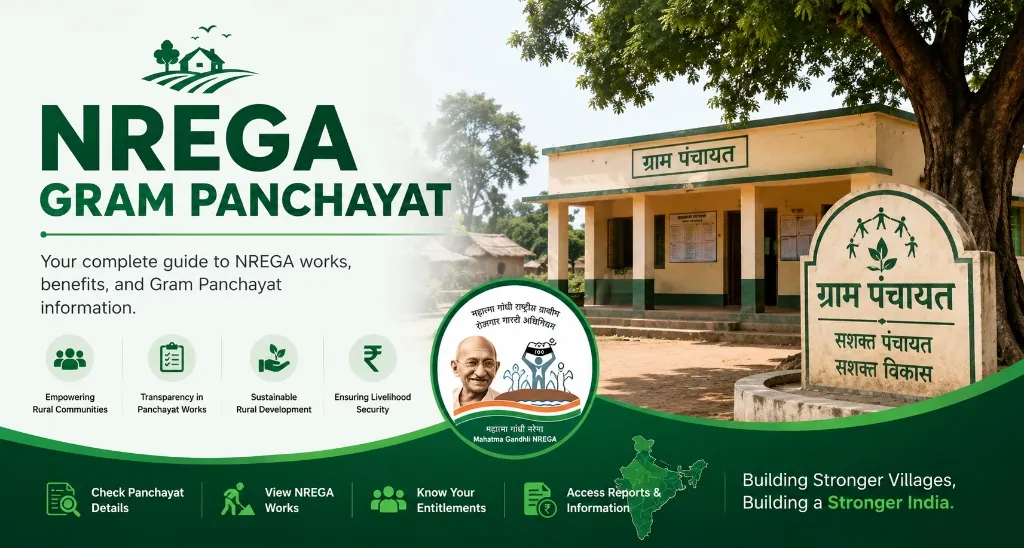
NREGA Gram Panchayat: Local Work Details, Roles & Village Lists
The NREGA Gram Panchayat plays a central role in implementing the Mahatma Gandhi National Rural Employment Guarantee Act at the village level. As the primary governing body close to the rural population, the local Panchayat serves as the main point of contact for workers seeking registration, work allocation, and payment details. Managing this scheme at the grassroots level ensures that the target households receive their legal employment benefits without facing unnecessary delays.
This comprehensive guide details the precise functions of the village body, how you can access localized work logs online, and how the recent structural updates affect daily workflows across rural areas.
- 1.What Is a NREGA Gram Panchayat?
- 2.BREAKING VALUE UPDATE: The July 2026 VB-G RAM-G Transition
- 3.How to Check the NREGA Gram Panchayat Job Card List (Online)
- 4.How to Check NREGA Gram Panchayat Work Details
- 5.Role of NREGA Gram Panchayat in Rural Employment
- 6.Responsibilities of NREGA Gram Panchayat Under NREGA
- 7.How the NREGA Gram Panchayat System Works
- 8.Track NREGA Gram Panchayat Corruption Online (2026 Social Audits)
- 9.Rights of Job Card Holders at the NREGA Gram Panchayat Level
- 10.Common Issues Faced at the NREGA Gram Panchayat Level
- 11.Frequently Asked Questions (FAQs)
- 12.Importance of NREGA Gram Panchayat in Scheme Implementation
What Is a NREGA Gram Panchayat?
The village governing body acts as the key executive agency for executing rural jobs. The Ministry of Rural Development delegates executive powers to the Panchayat to ensure direct implementation of public works. Unlike block or district offices, this local council interacts directly with citizens, receiving requests and issuing necessary job documents.
Under the statutory guidelines, the council is responsible for conducting regular planning assessments and managing funds allocated for village development. It operates in coordination with block coordinators to ensure transparency and accountability at every stage of the scheme.
BREAKING VALUE UPDATE: The July 2026 VB-G RAM-G Transition
Starting July 1, 2026, the central government has initiated a significant transition to the new Viksit Bharat Guarantee for Rozgar and Ajeevika Mission Gramin framework. Under this transition, the local Panchayat is undergoing major technical and operational changes to improve governance and asset quality.
Viksit Gram Panchayat Plans
Village planning will no longer be done manually. Panchayats are now required to use GIS-based tools and PM Gati Shakti data to plan durable, climate-resilient community assets before receiving funding.
New Guarantee Cards
While your existing verified Job Card remains valid during the transition period, the local council will gradually replace it with the newly updated, digitally-linked Gramin Rozgar Guarantee Card.
Mandatory 60-Day Pause: Panchayats must now suspend all public NREGA works for 60 days during peak agricultural sowing and harvesting seasons to ensure farmers have enough local labor.
How to Check the NREGA Gram Panchayat Job Card List (Online)
Rural workers often need to check if their names are registered in the active village database. To verify your registration status, the official portal provides detailed public reports for every region. You can easily view this database by visiting the official page for the Job Card guide on our website, which outlines the step-by-step checking process.
How to Check NREGA Gram Panchayat Work Details
Citizens have the right to inspect the complete list of projects being executed in their village. You can check these details online by accessing the reports portal and selecting your state, district, block, and Panchayat parameters. Navigating to the R5 Work reports section will show the list of approved works.
The project directory lists all road construction, farm pond excavation, water conservation dams, and other local infrastructure works. Checking this register allows you to verify that funds are being utilized for genuine public projects in your neighborhood.
Role of NREGA Gram Panchayat in Rural Employment
The role of the local governing council extends to every phase of scheme delivery. The Panchayat is responsible for registering households, assessing local employment demand, preparing annual project lists, allocating jobs, and monitoring worksites daily. It acts as a bridge between the central database and the daily wages of rural families.
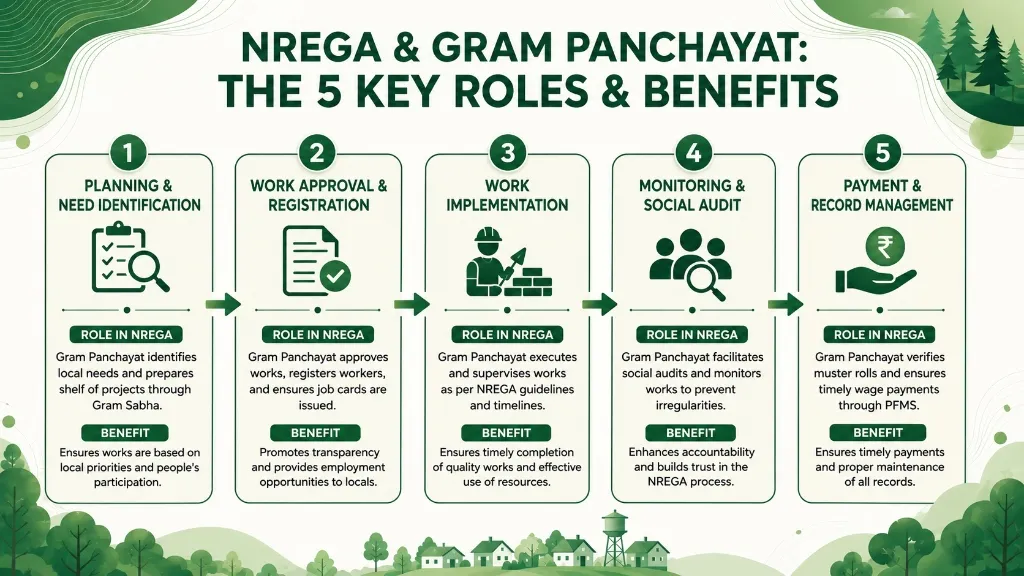
Additionally, the village body coordinates with the Block Programme Officer to process muster rolls and generate payment orders. This active participation ensures that the benefits of the scheme are distributed fairly among all eligible households.
Responsibilities of NREGA Gram Panchayat Under NREGA
The core responsibilities of the Panchayat include verifying applications, issuing Job Cards free of cost, and allocating work within 15 days of receiving a demand. The council must also ensure that basic facilities such as clean drinking water, shade, and first aid are provided at worksites.
Furthermore, the council is responsible for updating the local database with details of active workers and processing bank account links. This ensures that wages are directed to the correct beneficiaries without any leakage.
How the NREGA Gram Panchayat System Works
The operational flow at the village level follows a structured sequence. It starts with household registration and work demand submission, followed by worksite allocation, attendance tracking, and final payment processing. The entire workflow relies on close coordination between workers and local Panchayat assistants.
To understand this process clearly, explore the interactive workflow explorer below:
Step 1: Registration & Verification
Panchayats receive applications from rural households, verify their local residence status, and officially register the family in the database.
Resulting MIS Document: The official Job Card is issued and recorded in the online Gram Panchayat Registration List.
Step 2: Accepting Work Demand
Workers submit an oral or written demand for work. The Panchayat must issue a dated receipt and allocate suitable work within 15 days.
Resulting MIS Document: Work Allocation Order is generated, linking the worker to a specific approved worksite.
Step 3: Work Execution & Attendance
The village Mate oversees the worksite and captures daily geo-tagged photos of workers twice a day using the official mobile app.
Resulting MIS Document: The active E-Muster Roll is updated daily on the public portal.
Step 4: Processing Wage Payments
Once the weekly work cycle ends, the Panchayat closes the muster roll and pushes the verified logs to block officers to release funds.
Resulting MIS Document: The Fund Transfer Order is generated and tracked via the payment dashboard.
Track NREGA Gram Panchayat Corruption Online (2026 Social Audits)
To ensure high standards of transparency, the central government has intensified independent social audits across all villages. These audits check local registers against physical worksites to stop irregularities and funds leakage.
How to use the Social Audit Individual Issue Listing Tool: Open the official reports portal, navigate to the Social Audit reports section, select the current Financial Year along with your village parameters, and click on the Issue Listing report link to view active audit cases.
You can check these findings online by accessing the Social Audit section on the official portal. Filtering by your village reveals the audit logs, showing if the local council has been flagged for issues like fake registrations or missing materials. If you find irregularities, you should present them during the next Gram Sabha meeting in your area.
Rights of Job Card Holders at the NREGA Gram Panchayat Level
Workers have strong legal protections under the employment act. Every cardholder has the right to demand work, receive allocation within 5 km of their home, and get paid minimum wages within 15 days of muster roll closure. If the local body fails to allocate work on time, workers are entitled to receive a daily unemployment allowance.
If you face any issues with your wage credits, checking your status via the official Payment guide will help you identify if the delay is due to Aadhaar seeding or processing errors.
Common Issues Faced at the NREGA Gram Panchayat Level
Despite strong regulations, workers occasionally face operational challenges. These include delays in issuing cards, incorrect work entries, and network issues during mobile attendance logging. Most of these problems can be resolved by contacting the local Panchayat Secretary or filing a grievance online.
For official rules and guidelines, you can also refer directly to the central resources on the Ministry of Rural Development website to understand the correct escalation path.
Household Registration & Verification
Families submit their job card applications at the local council office. Local authorities verify residence records and issue the official card register booklet.
Work Demand Submission
Registered workers demand employment orally or in writing. Panchayat assistants record this demand on the portal and issue a dated receipt.
Project Selection & Allocation
Panchayat planners select approved projects based on the village plan and allocate employment to applicants within fifteen days.
Daily Work Execution & NMMS Logging
Workers execute the designated project tasks. The worksite supervisor records daily attendance with geo-tagged photos twice a day on the official app.
Fund Transfer Order (FTO) Release
After closing the weekly register, officials verify the records to generate the fund transfer orders for direct bank transfers to Aadhaar-linked accounts.
Frequently Asked Questions (FAQs)
1. What is the role of the Gram Panchayat in MGNREGA?
2. Who is responsible for issuing the NREGA Job Card?
3. How can I check my Gram Panchayat NREGA work list?
4. What happens if the Gram Panchayat cannot provide work?
Importance of NREGA Gram Panchayat in Scheme Implementation
The local governing body represents the foundation of rural development. By connecting rural households directly with the national database, it ensures that benefits are delivered in a transparent manner. Maintaining active coordination helps create permanent assets and ensures long-term economic growth for the entire community.
Disclaimer: This website is an independent informational portal. It is not affiliated with, endorsed by, or associated with the Government of India or the Ministry of Rural Development. The official website of the scheme is nrega.nic.in. For official services and government records, please visit the official website directly.