NREGA Job Card: Online Registration & Regional List Check
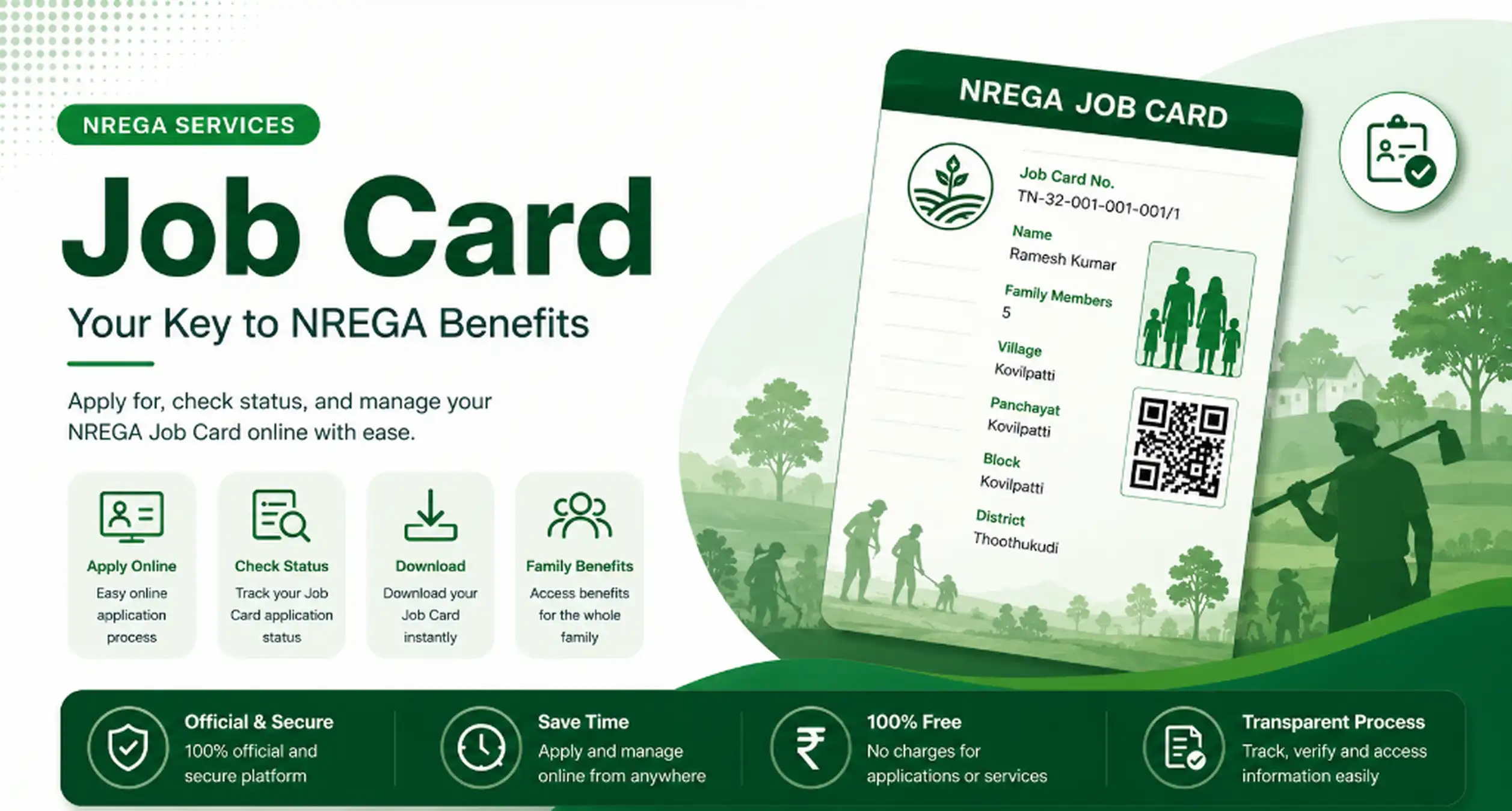
To secure employment in rural sectors and track your allocation of labor, obtaining a physical or digital nrega job card is your most critical step. The Mahatma Gandhi National Rural Employment Guarantee Scheme ensures that every household receives a legal entitlement to manual work. The database links registration logs directly to public account disbursements, meaning any updates to your status must register accurately to avoid clerical blocks or wage processing delays.
Keeping your profile active online serves as a vital safeguard against distribution blocks. In this comprehensive resource, we outline the exact parameters of the legal document, walk you through state codes, explain differences with labor cards, and provide the step-by-step instructions to search the Gram Panchayat directories without administrative credentials.
[Hide]
- 1.What is the Main Purpose of an NREGA Job Card?
- 2.Eligibility: Who Can Apply for a Job Card in 2026?
- 2.1.Women’s Representation and Legal Protections
- 3.NREGA Job Card Required Documents
- 4.How to Apply for an NREGA Job Card (Online & Offline)
- 4.1.NREGA Job Card Apply Online (UMANG App)
- 4.2.The Offline Gram Panchayat Process
- 4.3.नरेगा जॉब कार्ड कैसे बनता है? (Job Card Kaise Banta Hai?)
- 5.How to Check Status & Download NREGA Job Card PDF
- 6.NREGA Job Card List 2026: Check Gram Panchayat & District Wise
- 6.1.NREGA Job Card Status & Resolution Finder
- 7.NREGA Job Card State Codes: Complete 36 States & UTs List
- 8.Top State-Wise NREGA Job Card Portals
- 9.Understanding Your NREGA Job Card Number Format
- 9.1.How to Search and Retrieve Your Lost Job Card Number
- 10.Legal Rights and the VB-G RAM G Job Card Update
- 11.Job Card vs. Labour Card: What is the Difference?
- 12.Frequently Asked Questions (FAQs)
- 13.Secure Your Rural Employment Rights
What is the Main Purpose of an NREGA Job Card?
The primary purpose of this registry card is to provide a solid legal framework for rural households seeking unskilled manual labor. Under national guidelines, it serves as a dual-purpose document: first, it registers a family’s request for work, and second, it records the physical days of employment completed at local developmental worksites. By holding this card, rural families are legally protected and guaranteed up to 125 days of wage employment in a financial year under the new VB-G RAM G Act, ensuring a basic livelihood safety net. This legal guarantee forms the backbone of social security in rural communities, mitigating seasonal unemployment.
Every entry on the card, including the days worked, type of project, and wages paid, is tracked in the public database, which directly prevents middlemen from withholding or diverting worker salaries.
The card is linked to a bank account, allowing wages to be deposited directly. The digital entries create an open audit trail for rural infrastructure expenditures.
Official Website Access: You do not need to register a personal profile on the main portal to check the public listings. The Ministry of Rural Development hosts all Gram Panchayat registers for public viewing at nrega.nic.in. For other related tutorials, please check our homepage to view registration codes and guides.
Eligibility: Who Can Apply for a Job Card in 2026?
Understanding the eligibility parameters is the first step to securing registration. The application rules are inclusive but have specific legal requirements to ensure that assistance goes to targeted rural households. The program is designed to support the local rural economy, and thus eligibility focuses strictly on residential status and age criteria. Once registered, you can view comprehensive Panchayat data by reading our guide to check NREGA MIS reports.
NREGA Job Card Eligibility Requirements
The scheme does not discriminate based on caste, creed, gender, or social background. Special categories of rural households, such as Particularly Vulnerable Tribal Groups (PVTGs), nomadic tribes, and families headed by disabled individuals, are actively encouraged to apply.
Women’s Representation and Legal Protections
To promote female empowerment in rural sectors, the scheme enforces strict gender inclusion guidelines. National rules mandate that at least one-third (33%) of the total workforce employed under the act in each block must be women. Additionally, female workers receive equal wages matching the male wage rates, and local Panchayats are obligated to provide drinking water, first-aid, and creche facilities for infants at worksites where female workers are active.
NREGA Job Card Required Documents
To apply for registration, you must present proof of identity and local residency. Block officers and the local Panchayat GRS require the following documents to process Form 1 without delays. Accurate documentation is essential because all details must align with the national public financial systems to ensure direct bank transfers execute successfully.
The primary document required is the Aadhaar Card. Aadhaar seeding is mandatory to prevent duplicate entries and ensure that the worker’s identity is verified through biometric records. If Aadhaar is not seeded, the wage payment system may flag the account, causing electronic transfer rejections. Along with Aadhaar, the Voter ID card acts as solid proof of residency within the specific Gram Panchayat boundary, ensuring that only local villagers benefit.
You must provide at least one official government-issued ID card to verify your name, age, and details:
- Aadhaar Card (Mandatory for Aadhaar seeding)
- Voter ID Card (EPIC)
- Ration Card (Household details)
These auxiliary documents help verify bank credentials and local village residency:
- Active Bank Passbook (First page copy)
- Recent Passport Size Photographs
- Mobile number linked to bank account
Attention: Workers must double-check that the name written on their Aadhaar card matches the spelling on their bank passbook exactly. A minor spelling discrepancy can cause the Aadhaar Enabled Payment System (AEPS) to reject the digital wage transfer.
How to Apply for an NREGA Job Card (Online & Offline)
Applicants have two primary routes to register their households. You can use the official UMANG application interface or visit your local village office in person to file the request. Both paths follow the same verification rules, and no fees are charged.
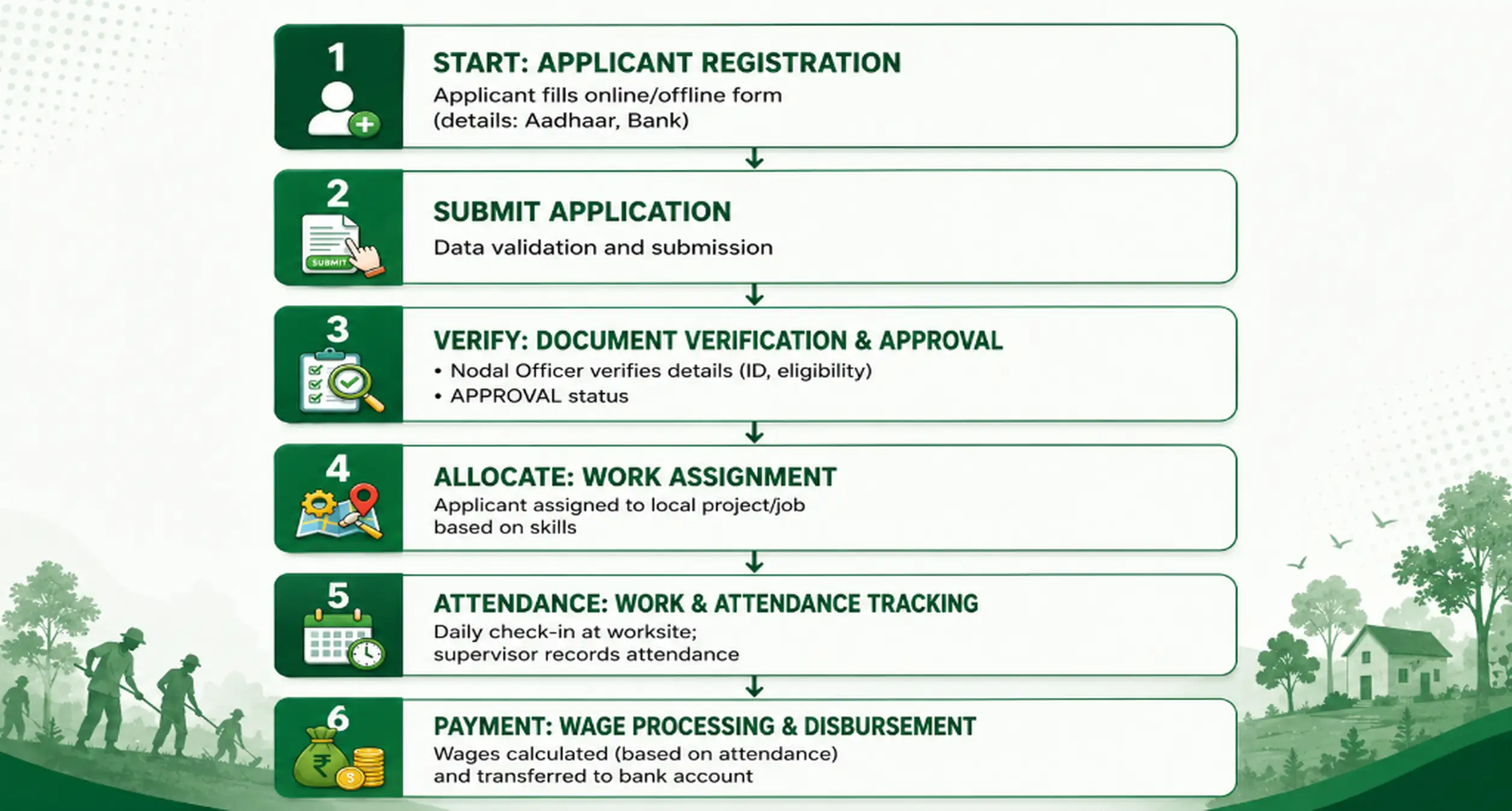
- App Download: Download the UMANG app, register your profile, and search for the MGNREGA department service list.
- Details Submission: Select the Apply for Job Card option, input your household details, and upload scans of photographs and identity proofs.
- BDO Routing: The application routes to the Block Development Office, which assigns the local Gram Rozgar Sahayak (GRS) to verify original documents.
- ID Generation: Following a successful home verification, the digital profile is approved, and your new card ID is generated.
- Form Collection: Collect Form 1 from your Gram Panchayat office or write a registration request listing all adult household members.
- GRS Submission: Submit the form along with passport size photos and Aadhaar card copies to your local GRS helper.
- Portal Entry: The GRS enters your household credentials into the central NregaSoft portal to register your request.
- Physical Distribution: The Panchayat GRS prints and distributes your physical book card within 15 days of receiving the request.
नरेगा जॉब कार्ड कैसे बनता है? (Job Card Kaise Banta Hai?)
ग्रामीण क्षेत्रों में नरेगा जॉब कार्ड बनवाना बहुत आसान है। यदि आप ऑफलाइन आवेदन करना चाहते हैं, तो अपने ग्राम पंचायत कार्यालय (GRS) में जाकर फॉर्म 1 जमा करें। इसके साथ अपना आधार कार्ड, बैंक खाता पासबुक और पासपोर्ट आकार की फोटो संलग्न करें। आवेदन प्राप्त होने के 15 दिनों के भीतर पंचायत आपके परिवार का नया जॉब कार्ड जारी कर देती है। ऑनलाइन आवेदन करने के लिए उमंग (UMANG) मोबाइल ऐप का उपयोग किया जा सकता है, जहां आवश्यक विवरण भरकर दस्तावेज अपलोड करने होते हैं। इसके बाद ग्राम रोजगार सहायक आपके घर आकर दस्तावेजों का भौतिक सत्यापन करते हैं और प्रक्रिया पूरी होने पर डिजिटल जॉब कार्ड जारी कर दिया जाता है।
How to Check Status & Download NREGA Job Card PDF
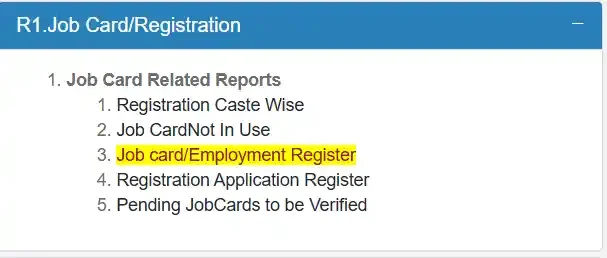
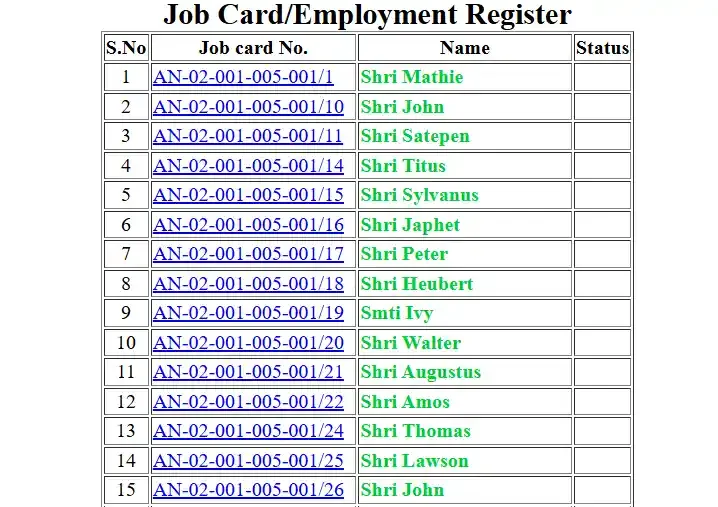
If you have already submitted your application, you can check its status and download a digital copy on the portal. Go to nrega.nic.in, click on the Generate Reports link, select your location parameters, and navigate to the Job Card/Employment Register report. Looking for your name in the Gram Panchayat register. Clicking on your card ID loads a digital layout showing your profile, employment history, and total wages. You can save this screen as a PDF or print it for reference. This digital copy is legally valid for obtaining work.
Quick PDF Download Steps
NREGA Job Card List 2026: Check Gram Panchayat & District Wise
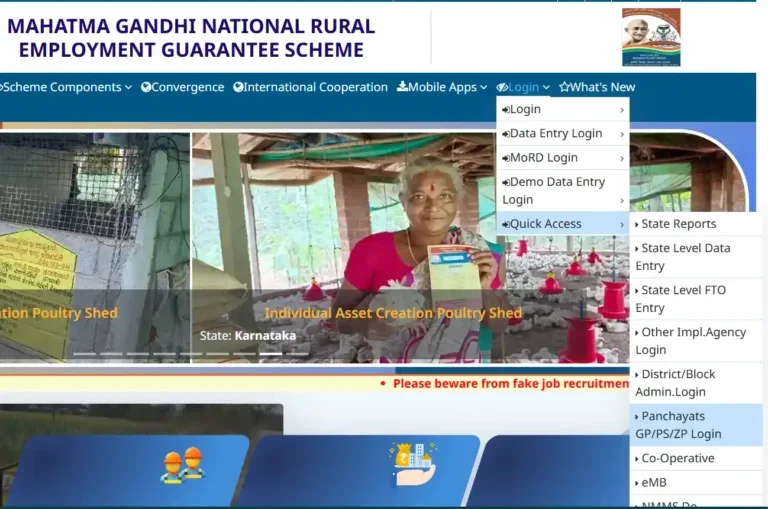
To verify if your registration is active and review the complete list of beneficiaries in your village, follow this easy step-by-step checking guide. We have matched each step with screenshots from the official government portal to help you navigate the system easily. Keeping track of this list ensures that your household records remain active in the local database, allowing you to participate in upcoming developmental works.
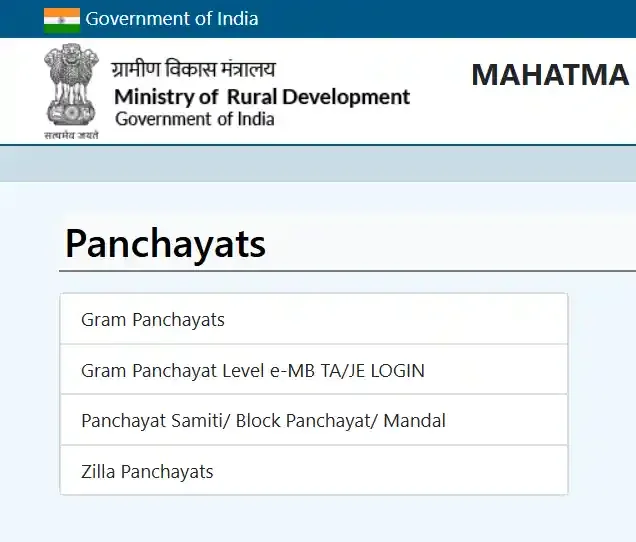
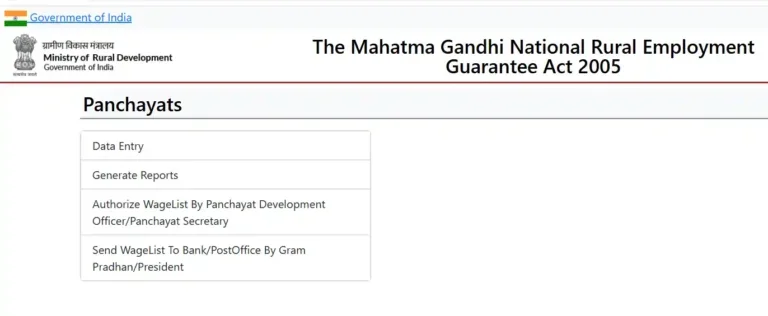
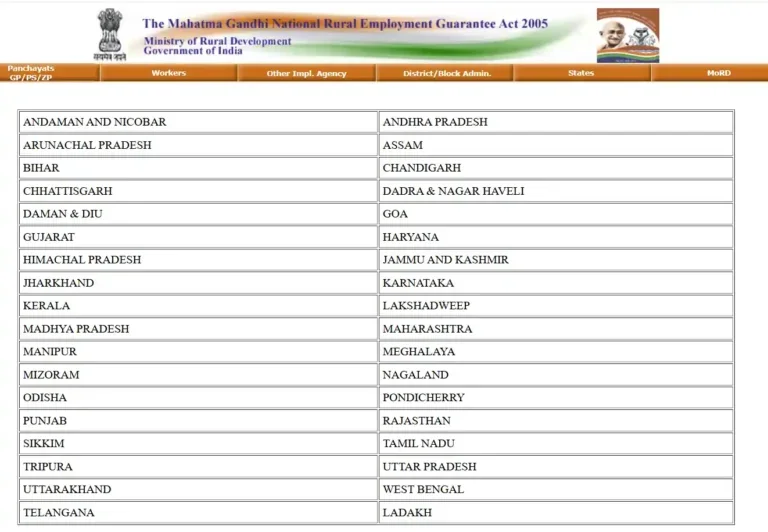
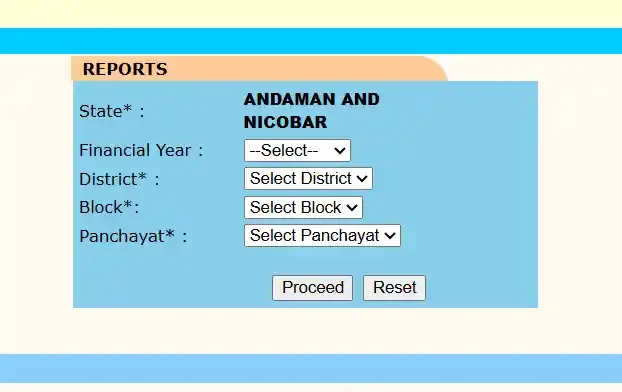
NREGA Job Card Status & Resolution Finder
Use our interactive tool below to check the meaning of color highlights and find out exactly what steps you need to take to resolve issues.
Select your card’s color highlight to find its operational status and resolution steps.
Select a color from the dropdown above to view its meaning and required actions.
NREGA Job Card State Codes: Complete 36 States & UTs List
Every card number is generated according to an administrative format. The first two characters of the ID represent the State Code. For example, AP represents Andhra Pradesh, BR represents Bihar, and UP represents Uttar Pradesh. Knowing your state code is essential when reading local registry reports. Review the complete list of regional codes below to understand your document details:
| State / Union Territory Name | State Code | Sample Job Card Prefix |
|---|---|---|
| Andaman and Nicobar Islands | AN | AN-02-001… |
| Andhra Pradesh | AP | AP-03-002… |
| Arunachal Pradesh | AR | AR-04-001… |
| Assam | AS | AS-05-003… |
| Bihar | BR | BR-06-001… |
| Chandigarh | CH | CH-07-001… |
| Chhattisgarh | CG | CG-08-002… |
| Dadra and Nagar Haveli and Daman and Diu | DN | DN-09-001… |
| Delhi | DL | DL-10-001… |
| Goa | GO | GO-11-002… |
| Gujarat | GJ | GJ-12-001… |
| Haryana | HR | HR-13-003… |
| Himachal Pradesh | HP | HP-14-001… |
| Jammu and Kashmir | JK | JK-15-002… |
| Jharkhand | JH | JH-16-001… |
| Karnataka | KK | KK-17-004… |
| Kerala | KL | KL-18-001… |
| Ladakh | LA | LA-19-001… |
| Lakshadweep | LD | LD-20-001… |
| Madhya Pradesh | MP | MP-21-002… |
| Maharashtra | MH | MH-22-001… |
| Manipur | MN | MN-23-001… |
| Meghalaya | MG | MG-24-001… |
| Mizoram | MZ | MZ-25-002… |
| Nagaland | NL | NL-26-001… |
| Odisha | OR | OR-27-003… |
| Puducherry | PD | PD-28-001… |
| Punjab | PB | PB-29-001… |
| Rajasthan | RJ | RJ-30-002… |
| Sikkim | SK | SK-31-001… |
| Tamil Nadu | TN | TN-32-001… |
| Telangana | TL | TL-33-002… |
| Tripura | TR | TR-34-001… |
| Uttar Pradesh | UP | UP-35-001… |
| Uttarakhand | UK | UK-36-001… |
| West Bengal | WB | WB-37-002… |
These prefixes are generated systematically by the software database. When a new region is added or borders are modified, the administrative registry updates the code table accordingly. Workers can verify their regional code by checking the printed text at the top left of their card document.
Top State-Wise NREGA Job Card Portals
While the national portal hosts the main database, states like Rajasthan, Uttar Pradesh, Bihar, and Andhra Pradesh maintain local language redirects that speed up report queries. Localized servers permit citizens to search for names in regional scripts and run audits. Utilizing these state portals during peak hours avoids database timeouts. State servers are configured to handle localized queries quickly, providing access to village lists and wage reports during high traffic seasons.
Each state portal provides specific services tailored to regional development goals. For example, the Bihar state portal integrates directly with the state’s rural development department to show local employment statistics. Similarly, the Rajasthan portal offers dedicated modules for checking the state’s additional 25 days of employment guarantees.
Understanding Your NREGA Job Card Number Format
Your document displays a unique 14-digit alphanumeric code. This code is structured to map the worker’s precise location and ID in the national registry. The format follows this layout: ST-DD-BBB-PPP/HH-U. The breakdown is as follows:
- ST (2 characters): State Code (e.g. RJ for Rajasthan).
- DD (2 digits): District Code mapping the primary administrative region.
- BBB (3 digits): Block/Taluka Code indicating the administrative sub-district.
- PPP (3 digits): Panchayat Code mapping the specific group of villages.
- HH (4 digits): Unique Household registration ID in that village.
- U (1 digit): Suffix allocated to family members.
For example, if your card number is UP-03-010-002/0145-A, it indicates Uttar Pradesh (UP), District 03, Block 10, Gram Panchayat 02, Household 0145, and member A. If these codes do not match your actual village parameters, you should submit a correction request to the local Panchayat office to prevent administrative issues.
How to Search and Retrieve Your Lost Job Card Number
If you lose your card or forget your number, you can search by your name online. Navigate to the Gram Panchayat R1 report page for your village. Press Ctrl + F on your browser, type your name, and locate your row. The table lists your corresponding number link. Click the link to load and reprint your document details. You can also visit your Panchayat GRS who can search the database using your Aadhaar number.
Legal Rights and the VB-G RAM G Job Card Update
Under the latest rural guidelines (effective July 1, 2026), the MGNREGA scheme has been officially replaced by the VB-G RAM G Act. During this transition, your existing NREGA Job Card remains fully valid as long as your Aadhaar is verified. The government has established a 6-month migration window ending on December 31, 2026. By this deadline, all active workers will gradually be issued the new Gramin Rozgar Guarantee Card.
You do not need to panic or immediately apply for a new card. All registered households must simply ensure they have seeded their bank accounts with Aadhaar numbers for the Aadhaar Payment Bridge System (APBS) to continue receiving wages smoothly.
Workers have key legal rights under the scheme. If an eligible household applies for work, the administration is legally obligated to allocate work within 15 days of receiving the request. The worksite must be located within a 5-kilometer radius of the worker’s residence. If work is assigned beyond this limit, the worker is entitled to an additional 10% travel allowance. All wages must be paid within 15 days of the completion of the work week.
Job Card vs. Labour Card: What is the Difference?
Many citizens confuse these two cards because both belong to rural workers. However, their legal rights, funding sources, and purposes are completely separate. Review the differences below to understand which card applies to your household’s needs and how they impact your social security benefits:
The main difference lies in the nature of work and the issuing authority. The NREGA card is a household-level document focused entirely on public works and guaranteed employment, whereas the Labour Card is an individual-level document that registers construction workers for welfare benefits.
Comparison Summary
NREGA Job Card:
Issued to rural households by the Ministry of Rural Development. Focuses strictly on providing 100 days of unskilled manual work. Payouts are funded by central and state budgets under the MGNREGA scheme.
Labour Card (BOCW):
Issued to individual construction workers by State Labour Departments. Focuses on providing welfare benefits, pensions, medical aid, and school scholarships. Funded by welfare cess collections.
Additionally, the registration and renewal cycles differ. NREGA cards are valid for 5 years and are renewed automatically by the Gram Panchayat. Labour cards, however, require regular annual subscription fees and active proof of 90 days of construction work.
Frequently Asked Questions (FAQs)
Is the NREGA job card application free of cost?
Yes. Applying for registration, checking the online lists, and downloading your card details is 100% free of cost. Gram Panchayat officials and block workers are legally prohibited from demanding any fees.
How many days of work are guaranteed in 2026?
Traditionally, the MGNREGA scheme guarantees 100 days of wage employment per household in a financial year. However, under the new 2026 VB-G RAM G framework updates, verified eligible households can demand up to 125 days of work.
How long is a MGNREGA card valid?
A job card is valid for five years from the date of registration. The head of the household can renew the card at the Gram Panchayat office for another five-year period without paying any fees.
What happens if the Panchayat cannot provide work?
If the local Gram Panchayat fails to allocate work to a registered card holder within 15 days of receiving their work application, the state government is legally obligated to pay an unemployment allowance.
Why is my name missing from the NREGA Job Card List?
Your name may be missing if the card has expired (needs renewal after 5 years), if your e-KYC verification is incomplete, or if block officers suspended the card due to duplication or address mismatch. Visit your Panchayat office to submit your Aadhaar card and reactivate the entry.
Is the new 125-day work rule active right now?
It depends on your state. While the central VB-G RAM G Act mandates 125 days, states were given a 6-month window in 2026 to notify and operationalize their specific schemes. Check your local state portal for exact activation dates.
I lost my old NREGA card. Do I apply for a new VB-G RAM G card?
During the transition period, you should simply request a duplicate of your existing verified card from the Gram Panchayat. Brand new registrations specifically branded as “VB-G RAM G” are still being rolled out by state IT departments.
Secure Your Rural Employment Rights
Checking your NREGA Job Card details and monitoring your active listings regularly is crucial to secure your livelihood. If you have verified your card details, the next step is monitoring worksite logs. For official verification and notifications, you can visit the official portal at nrega.nic.in directly to log queries. Monitoring your profile ensures that your household continues to receive benefits without database blocks.
Disclaimer: This website is an independent informational portal and is not affiliated with, endorsed by, or associated with the Government of India, the Ministry of Rural Development, or any state administration. The official website of the scheme is nrega.nic.in. For official services and government records, please visit the official website directly.